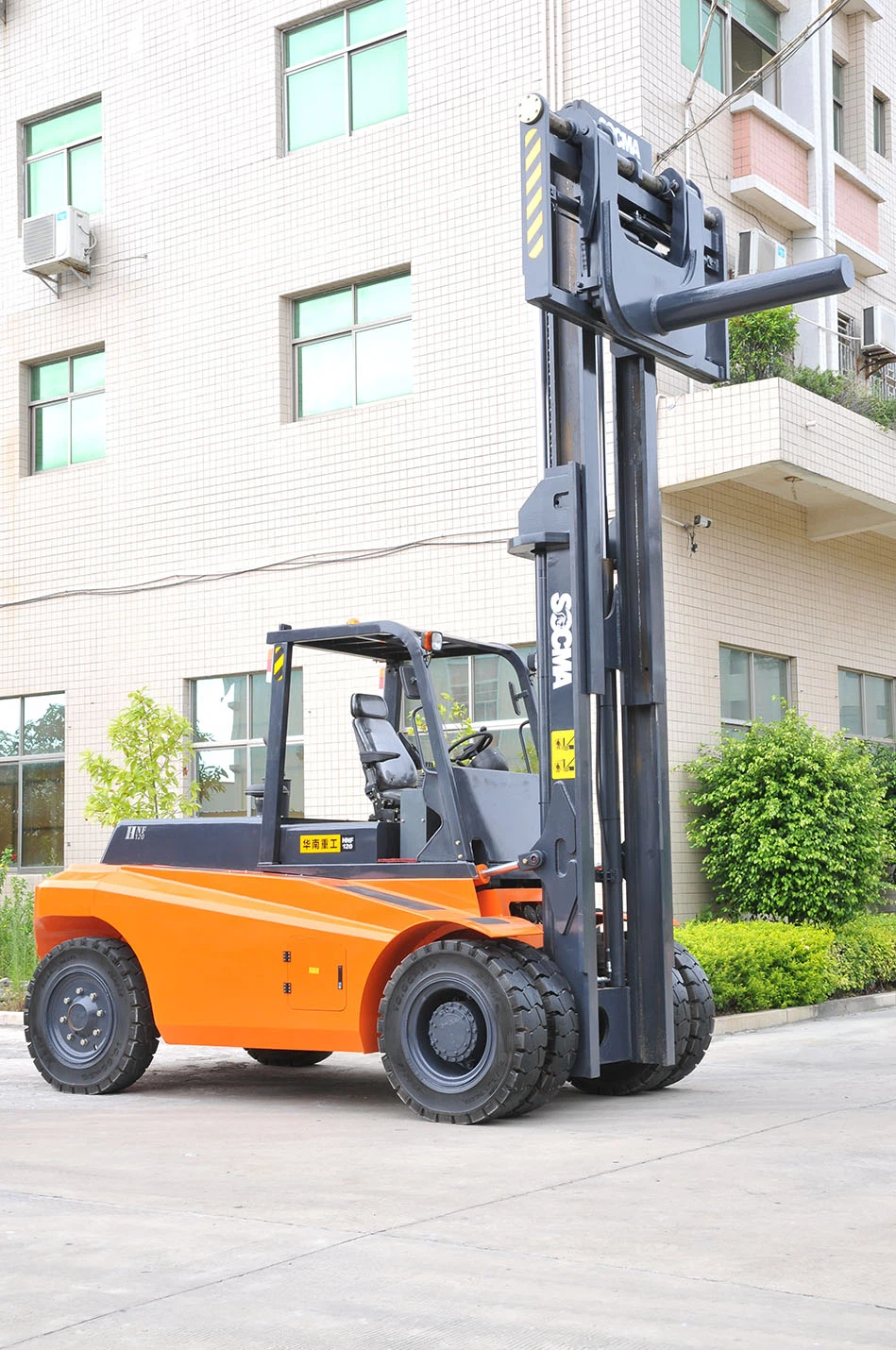
Attachments/Accessories can help to increase the working efficiency so much. But how to choose a suitable attachment for your forklift?
Basic concepts related to attachments: After the attachments are installed on the forklift, the original design state of the forklift has actually been changed. Therefore, in the actual operation process, how will the forklift's carrying capacity change? Will it affect the operation and use of the forklift? Before analyzing the situation, it is necessary for us to understand the following concepts. These are the factors most closely related to the actual carrying capacity of forklifts; they are also indispensable for calculating and judging the comprehensive carrying capacity of forklifts.
(1) Load capacity: The load capacity of an attachment refers to the maximum weight that an attachment can safely carry under a certain load center.
(2) Load center distance: Load center distance refers to the distance from the front surface of the attachment frame to the center of gravity of the cargo.
(3) Lost load distance: the distance from the front surface of the fork frame to the front surface of the attachment frame (ie the thickness of the attachment).
Factors to be considered in the selection of attachments:
In the face of the working environment conditions, operation methods and different forklifts used or to be purchased by corporate customers in different fields, how to choose a forklift that is suitable for the working environment of your company? Usually, the customer must provide the actual working conditions and requirements of the attachment to the forklift OEM or its sales agent or attachment company. Based on these important information, the forklift OEM or its sales agent or attachment company can select the type of attachment.
(1) What kind of goods the customer carries out: such as paper rolls, soft bags, barrels, home appliances, tubes, pallets and other items.
(2) Cargo weight: (including pallet) kg, length (along driving direction) mm, width/diameter mm, height mm.
(3) Outer surface/contact surface (outer packaging).
(4) Transportation method: a. Pallet transportation: the size of the cargo pallet in mm, the height of the pallet jack in mm b. Non-pallet transportation: the distance between the cargo piles in mm, and the number of cargo pieces.
(5) Specific handling information/actual environment: How the customer will handle these goods: Pushing/clamping/rotating (horizontal to the direction of travel)/rolling (horizontal to the direction of travel)/moving sideways/rolling (along the direction of travel) / Loading on the rear of the car / Loading on the side of the car.
(6) Current customer status information: How has the customer solved the handling problem so far? How do they want to improve? What do they envision?
(7) What are the limitations in practical application: height, length, width, weight, others.
(8) Application fields of attachments: smelters, construction sites, warehouses, special occasions, etc.
(9) Environmental factors: explosive areas, dust, high temperature, low temperature, acidity, sugar, salt, food, nutrition, beverages, etc.
(10) Regarding forklifts: forklift model, mast type, type of attachment selected, action function, determine the number of additional oil circuits for the forklift according to the type and function of the attachment.