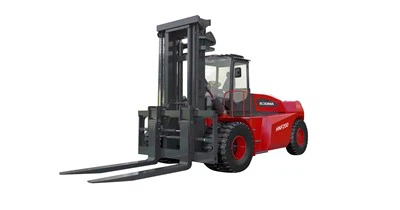
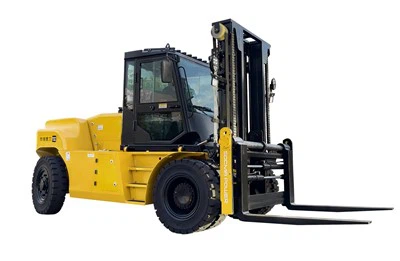
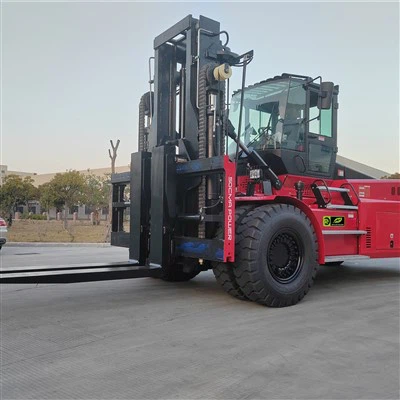
Sure, a 36-ton forklift is an absolute powerhouse in the industrial world. It's built to handle massive loads, making it a go-to for heavy-duty operations. But when it comes to using it in a narrow aisle, well, that's where things get a bit tricky.
First off, let's talk about the size of a 36-ton forklift. These beasts are massive. They're designed to carry extremely heavy loads, so they usually have a wide body, large tires, and a long wheelbase. All these features are great for stability and weight distribution when lifting heavy stuff, but they're not so great for navigating tight spaces.
A narrow aisle typically means less room for maneuvering. You need a forklift that can turn sharply, move in and out of tight spots without hitting anything, and generally be more agile than your average heavy-duty machine. With a 36-ton forklift, its large size can make it difficult to make those sharp turns or fit through the narrow gaps between storage racks.
Another factor to consider is the turning radius. The turning radius of a forklift is the amount of space it needs to make a complete turn. A 36-ton forklift usually has a relatively large turning radius because of its size. In a narrow aisle, this can be a real problem. You might find yourself struggling to position the forklift properly to pick up or drop off a load, which can slow down your operations and even increase the risk of accidents.
But hey, it's not all doom and gloom. There are some situations where a 36-ton forklift can still be used in a narrow aisle. For example, if the aisle is just wide enough for the forklift to pass through, and you don't need to make too many sharp turns, it might work. Also, if the loads you're handling are very heavy and there's no other forklift that can handle them, you might have to make do with a 36-ton forklift in a narrow space.


One solution is to modify the aisle layout. You can widen the aisles slightly to give the forklift more room to maneuver. This might require some investment in terms of floor space and modifications, but it can make a big difference in the efficiency and safety of your operations.
Another option is to use a forklift with special features designed for narrow aisles. Some forklifts come with a telescopic mast or a side-shifting carriage, which can help you pick up and move loads without having to reposition the forklift as much. However, finding a 36-ton forklift with these features might be a bit challenging.
As a 36-ton forklift supplier, I've seen it all. I know that every situation is different, and there's no one-size-fits-all answer. That's why it's important to assess your specific needs and the layout of your warehouse or industrial space before deciding whether a 36-ton forklift is suitable for your narrow aisle.
If you're still on the fence, I'd recommend looking at some of our other forklift models. For example, we have the SOCMA 13.5 Ton Forklift HNF135-600-A, which is a bit more compact and might be a better fit for narrower spaces. We also have the SOCMA 16 Ton Forklift HNF160-600-C and the SOCMA 25 Ton Forklift HNF250-1250-A, which offer a good balance between lifting capacity and maneuverability.
If you need an electric option, our SOCMA 20 Ton Electric Forklift is a great choice. It's environmentally friendly and can be more suitable for indoor use, which is often where narrow aisles are found. And of course, if you really need that 36-ton capacity, we also have the SOCMA 35 Ton Forklift HNF350-1250-A, which is very close in terms of load capacity.
If you're interested in learning more about our forklifts or want to discuss your specific requirements, don't hesitate to reach out. We're here to help you find the best solution for your business. Whether it's a 36-ton forklift for a narrow aisle or something else, we've got the expertise and the products to meet your needs.
References
- Industrial Forklift Handbook
- Guide to Warehouse Layout and Equipment
- Forklift Safety and Operations Manual