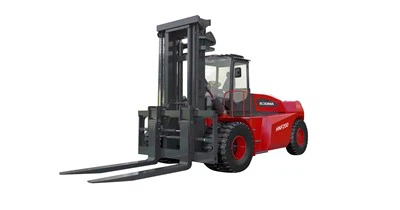
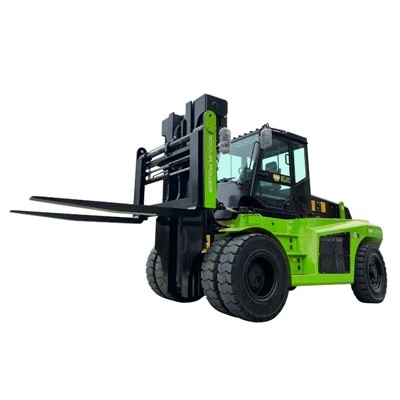
A forklift is an essential piece of equipment in many industries, including warehousing, construction, and manufacturing. When it comes to forklifts, one of the most significant factors to consider is the lifting capacity. A 20 - ton forklift is a heavy - duty machine designed for specific, large - scale tasks, while smaller forklifts are more versatile for a variety of general applications. In this blog, I'll explore the differences between a 20 - ton forklift and its smaller counterparts, and as a 20 - ton forklift supplier, I'll share insights that can help you make an informed decision for your business needs.
Structural Design and Build
One of the most obvious differences between a 20 - ton forklift and a smaller one lies in their structural design and build. A 20 - ton forklift is a behemoth. It is built with a robust frame and heavy - duty components to handle the immense weight it is designed to lift. The mast, which is the vertical assembly that raises and lowers the load, is much larger and stronger. The hydraulic cylinders used to power the mast are also of a higher capacity, capable of generating the force required to lift 20 tons.
In contrast, smaller forklifts, such as those with a capacity of 1 - 5 tons, have a more compact and lightweight design. Their frames are not as thick or heavy, and the mast and hydraulic systems are sized accordingly. This makes them more maneuverable in tight spaces like narrow aisles in a warehouse. For instance, a standard warehouse forklift with a 3 - ton capacity can easily navigate through spaces where a 20 - ton forklift would not fit.
Power and Performance
The power source and performance capabilities of a 20 - ton forklift and a smaller one are quite different. A 20 - ton forklift usually runs on a powerful diesel engine. Diesel engines provide the high torque needed to lift and move heavy loads. They are also more fuel - efficient when dealing with continuous heavy - duty operations. The large engine also allows the forklift to maintain a stable speed while carrying a 20 - ton load around the worksite.
Smaller forklifts can be powered by various means, including electric motors, gasoline, or propane. Electric forklifts are popular for indoor use because they produce zero emissions and are relatively quiet. They are ideal for light - to medium - duty tasks in a confined environment. For example, an SOCMA 12 Ton Electric Forklift is suitable for warehouses where air quality and noise levels are a concern. Gasoline and propane - powered forklifts offer a good balance between power and cost, and they are often used for outdoor tasks where emission regulations are less strict.
In terms of speed and acceleration, smaller forklifts are generally faster and more agile. They can quickly move around a worksite, change directions, and pick up and drop off loads. A 20 - ton forklift, on the other hand, is designed for stability and strength rather than speed. It moves at a more sedate pace to ensure the safety of the load and the operator.
Lifting Height and Reach
The lifting height and reach capabilities also vary significantly between a 20 - ton forklift and a smaller one. A 20 - ton forklift is typically designed for lower - height, high - weight applications. In most cases, its primary purpose is to move extremely heavy loads short distances or to stack them at a relatively low height. For example, in a steel mill, a 20 - ton forklift might be used to move large steel coils from one location to another or to stack them no more than a few meters high.
Smaller forklifts, especially those designed for warehousing, can have much greater lifting heights. Some smaller electric forklifts can reach heights of up to 10 - 12 meters. This makes them perfect for multi - level racking systems in warehouses, where goods need to be stored and retrieved from different levels. The smaller size also allows them to get closer to the racks and pick up or place items with greater precision.
Cost and Maintenance
The cost of purchasing a 20 - ton forklift is substantially higher than that of a smaller forklift. Not only is the initial purchase price high due to the large - scale components and powerful engine, but the cost of shipping and installation is also significant. In addition, 20 - ton forklifts require specialized training for operators, adding to the overall cost of ownership.
Maintenance costs for a 20 - ton forklift are also higher. The larger components and more complex hydraulic and electrical systems mean that parts are more expensive to replace. And because the forklift is often used in a heavy - duty environment, the wear and tear on the machine are greater. Regular maintenance, including engine tune - ups, hydraulic fluid changes, and mast inspections, needs to be carried out more frequently to ensure the safe and efficient operation of the forklift.
Smaller forklifts are generally more affordable to purchase and maintain. The parts are less expensive, and the maintenance procedures are often simpler. For example, an electric forklift has fewer moving parts compared to a diesel - powered 20 - ton forklift, which means there is less to go wrong and less frequent maintenance is required.
Application and Use Cases
The application and use cases for a 20 - ton forklift and a smaller one are distinct. A 20 - ton forklift is mainly used in industries where extremely heavy loads need to be moved. These include the steel industry, where it can handle large steel bars and coils; the mining industry, for moving heavy mining equipment and ores; and the shipping industry, for loading and unloading heavy containers from ships.
Smaller forklifts are more widely used across a variety of industries. In the retail sector, they are used to move pallets of goods in the backroom of stores. In the food and beverage industry, they are used to handle crates and cartons. For example, an SOCMA 15 Ton Electric Forklift can be used in a large - scale food distribution center to move heavy pallets of products.
As a supplier of 20 - ton forklifts, I understand the specific needs of businesses that require this type of heavy - duty equipment. If you are in an industry where large and heavy loads are a part of your daily operations, a 20 - ton forklift can be a valuable asset. However, if your requirements are more diverse and involve lighter loads and greater maneuverability, a smaller forklift might be a better choice.


If you're considering purchasing a forklift, whether it's a 20 - ton forklift or a smaller one, I'm here to help. We have a range of high - quality forklifts, including the SOCMA 16 Ton Forklift HNF160 - 600 - C and the SOCMA 35 Ton Forklift HNF350 - 1250 - A. Our team of experts can provide you with detailed information, help you choose the right forklift for your needs, and offer after - sales support. Contact us to discuss your forklift requirements and start the procurement process.
References
- “Forklift Operator's Manuals,” various forklift manufacturers.
- Industry reports on heavy - duty and general - purpose forklifts.
- Technical specifications from forklift component suppliers.