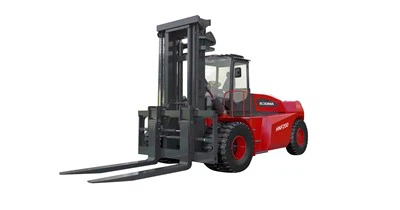
Hey there! As a supplier of 32 Ton Telehandlers, I often get asked about how to adjust the hydraulic flow on these beasts. It's a crucial aspect of maintaining and optimizing the performance of your telehandler, so I thought I'd share some insights.
First off, let's understand why adjusting the hydraulic flow is important. The hydraulic system in a 32 Ton Telehandler is what powers all the lifting, telescoping, and tilting functions. If the flow isn't right, you might experience slow operations, excessive power consumption, or even damage to the hydraulic components. So, getting it just right is key.


Now, before you start tinkering with the hydraulic flow, make sure you take all the necessary safety precautions. Turn off the telehandler and let it cool down. Also, wear appropriate safety gear like gloves and safety glasses. You don't want to get any hydraulic fluid in your eyes or on your skin, trust me.
The first step in adjusting the hydraulic flow is to locate the flow control valve. This valve is usually located near the hydraulic pump. In most 32 Ton Telehandlers, it's easily accessible, but you might need to refer to the machine's manual if you're having trouble finding it. Once you've found the valve, you'll notice that it has an adjustment screw or a knob.
To adjust the hydraulic flow, turn the adjustment screw or knob carefully. If you turn it clockwise, it will generally increase the hydraulic flow, and if you turn it counterclockwise, it will decrease the flow. But here's the thing - you can't just go crazy turning it. You need to make small adjustments and test the telehandler's performance after each adjustment.
For example, start by making a quarter - turn adjustment. Then, start up the telehandler and operate the lifting, telescoping, and tilting functions. Notice how the machine responds. Is it moving faster or slower than before? If it's too fast, you might be increasing the flow too much, and if it's too slow, you might need to increase the flow a bit more.
Another important thing to consider when adjusting the hydraulic flow is the type of work you'll be doing. If you're doing heavy - lifting tasks, you might need a higher hydraulic flow to get the job done quickly. On the other hand, if you're doing more precise work, a lower flow might be better for more accurate control.
Let me tell you about some of the other telehandlers we offer. We also have the 4Ton 7meter Telehandler Electric Telescopic Loader Forklift. This electric telehandler is great for indoor work or places where you need to be more environmentally friendly. It still has a decent lifting capacity and the hydraulic system is just as important to keep in tune.
If you need something with a bit more muscle, we have the SOCMA 20 Ton 10 Meter Telescopic Forklift HNT20010 - 4Z. This bad boy can handle some serious loads, and again, getting the hydraulic flow right is crucial for its performance.
The SOCMA 7 Ton 17 Meter Telescopic Forklift HNT7017 - 4Z is another great option. With its long reach, it's perfect for jobs where you need to access hard - to - reach areas. And having the correct hydraulic flow will ensure that it operates smoothly and efficiently.
Our SOCMA 11Ton Telescopic Forklift HNT110 is a versatile machine that can handle a variety of tasks. Whether you're in construction or a warehouse, getting the hydraulic flow adjusted properly will make your work a lot easier.
And for those jobs that require a bit more precision and a medium - sized load, the SOCMA 7.5 Ton 10 Meter Telescopic Forklift HNT7510 - 4Z is a great choice. Adjusting the hydraulic flow on this telehandler will help you achieve better control and performance.
Adjusting the hydraulic flow on a 32 Ton Telehandler isn't rocket science, but it does require some patience and attention to detail. If you're not comfortable doing it yourself, I'd recommend getting a professional to handle it. They have the expertise and the right tools to make sure the adjustment is done correctly.
If you're interested in any of our telehandlers or have any questions about hydraulic flow adjustment or anything else related to these machines, don't hesitate to reach out. We're here to help you make the most of your equipment and get the job done right. Contact us for more information and let's start a discussion about which telehandler is right for your needs and how we can assist you in optimizing its performance.
References:
- Manufacturer's manual for 32 Ton Telehandlers.
- Hydraulic system textbooks for industrial equipment.