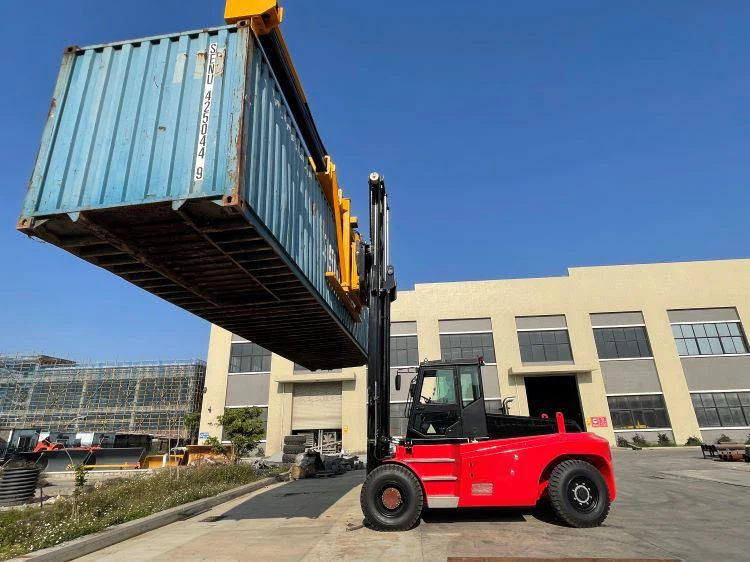
What will the forklift of the future look like?
What kind of powertrain does it rely on to drive it, and how will it be used? In the "Thesen am Tresen" - "Bar discussion" organized by STILL, a KION Group company, four experts from different fields were involved, and they discussed the way out and decision-making for forklift trucks, and what to expect.
According to Daniel Kuster, supply chain director at the Warsteiner Group in Germany, a diesel forklift is needed to increase the "speed of production". Kuster's day job involves carrying heavy beer trays over long distances. In this particular environment, Kuster is convinced that diesel forklifts can still play an important role with heavy loads and that no alternative drive will provide a suitable replacement anytime soon. Kuster was one of the panellists on "Thesen am Tresen" (discussion in the bar), the first multi-round debate organised by STILL and part of the German Logistics Congress 2021. This time, the topic of the debate is "Everything but exhaust: this is what the forklifts of the future will look like". Kuster's opening remarks directly challenged the title. Paradoxically, he thinks the future will see a variety of different driving forces, depending on the application required, "The internal combustion forklift may be dead - but the old dog has life!"
In principle, everyone is happy to agree that hybrid drives are the way of the future, however, there is disagreement about the weight and relevance of individual drive forms. This is exactly what the STILL discussion format is for. Dr. Thorsten Schmidt, professor of technical logistics at the Technical University of Dresden in Germany, is a proponent of internal combustion engines, but he believes that whether these should be powered by diesel fuel is still up for debate. Schmidt points out that there is a lot of research going on in this area, for example into synthetic fuels, and boldly predicts that it will never be possible to reduce the charging time of electric forklifts so that they can compete with the rapid refueling of fuel pumps. Therefore, the internal combustion engine still has a slight advantage in this regard, whether in shift work or continuous use.
Rolf Beckmann, a staunch proponent of electric forklifts, sees things differently. Beckmann, Engineering Director at Fiege Logistik Stiftung, represents contract logistics and the unique challenges faced in this field, responding flexibly to various requirements. Beckmann is a firm believer in the further development of lithium-ion batteries, and he even said that at higher ranges "battery replacement will no longer be an issue." He also noted that hydrogen as a possible energy source is often forgotten in public discussions. As far as the "future mix of drivers" is concerned, Beckmann's view is that it will be very diverse.
Frank Muller, Senior Vice President, Brand Management/Sales and Service Guidance, STILL EMEA, represented Engineering in the discussion. He believes that in the 3 to 5 ton field, electric forklifts are already as powerful as diesel engines. STILL has been researching hydrogen for many years and remains optimistic about further development. Muller is convinced that hydrogen will play a more prominent role in future trucks. However, he conceded that scaling may be required through a corresponding parallel development in the automotive industry.
Scientist Schmidt is more skeptical here, acknowledging that engineers have achieved impressive results with hydrogen fuel cells, but it is still a very expensive option, saying: "[Hydrogen] is technically feasible, but not very economical". Beckmann disagreed with this assessment, emphasizing the need to get into the game from a buyer's perspective, noting the possibility of using electrolyzers as storage media. Kuster from the Warsteiner Group is also open-minded in principle as a customer, but makes a "business case for hydrogen without politically motivated subsidies". So when it comes to long-term economic viability, the "ball" is firmly in the hands of engineers and producers to convince customers. Muller realized this too. As a manufacturer, he has noticed that STILL's customers are increasingly demanding sustainability. However, this can only be a promise with a corresponding price tag. STILL is well aware of this tension between sustainability and financial performance. At the same time, Muller stressed that many companies are still thinking too conservatively in this regard, warning that "in the medium term, the climate change we face will be more expensive than we can imagine."
On that basis, a completely different topic is changing the parameters in this regard. Is it possible that the overall look and function of the forklift will change in the future? Using an example, Beckmann asks the question: "Ten years from now, will people even be sitting on forklifts?" Kuster also highlights the growing need to focus on robotics. He explained that current e-commerce trends are changing a lot at the moment, especially in terms of speed, vehicle size and potential drive requirements, acknowledging that "it's pretty bad for sustainability". Speed and constant availability may drive the sustainability process in opposite directions. However, this is not yet a conclusion. "I still think conventional forklifts will be on the market for a long time because it handles diversity more efficiently," emphasizes Schmidt. In concluding remarks, Muller argued that "automation will continue to accelerate." He won't go too far, however, admitting that forklifts are on their way to obsolescence.