How does a 30 Ton Forklift work with automated systems?
As a trusted supplier of 30 - ton forklifts, I've witnessed firsthand the transformative power of automated systems in the industrial handling landscape. Automating a 30 - ton forklift doesn't simply mean adding a layer of technology; it fundamentally redefines how these heavy - duty machines operate, enhancing efficiency, safety, and productivity.
The Basics of a 30 - Ton Forklift
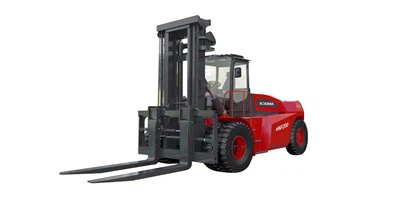
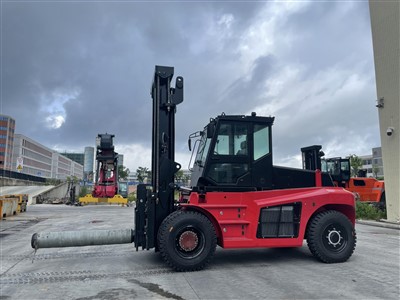
To understand how a 30 - ton forklift works with automated systems, we first need to grasp the basic components of the forklift itself. A 30 - ton forklift is a colossal machine designed to handle extremely heavy loads. It consists of a sturdy frame, powerful engines or electric motors, a mast for lifting and lowering the forks, and large, durable wheels or tires. The forks are the primary attachment used to lift and carry the load, and they can be adjusted to different widths to accommodate various cargo sizes.
The hydraulic system is a crucial part of the forklift. It uses hydraulic fluid to transmit power and enables the mast to lift the heavy loads with relative ease. When the operator activates the lift controls, a pump forces hydraulic fluid into cylinders, which then extend and raise the mast and forks.
Integration of Automated Systems
Automated systems are integrated into 30 - ton forklifts to streamline operations and reduce human error. These systems can be divided into several key components:
Navigation and Positioning
One of the most important aspects of automation is the ability to navigate the forklift accurately within a workspace. Automated 30 - ton forklifts often use a combination of technologies such as laser scanners, cameras, and GPS (in some outdoor applications). Laser scanners emit laser beams that bounce off surrounding objects, creating a 3D map of the environment. The forklift's control system uses this map to determine its position and plan a path to the target location.
Cameras can provide visual feedback about the surroundings, helping the forklift detect obstacles and avoid collisions. In indoor warehouses, cameras can also be used to read barcodes or QR codes on the floor or on shelves, which can be part of a larger inventory management system. For example, if a 30 - ton forklift needs to pick up a specific pallet from a rack, it can use the barcode or QR code information to identify the exact location of the pallet.
Load Management
Automated systems also play a vital role in load management. They can automatically adjust the forks to the correct width based on the size of the load. Sensors on the forks can detect the weight and balance of the load, ensuring that it is lifted and carried safely. If the load is unbalanced, the system can alert the operator or make adjustments to redistribute the weight.
In addition, automated forklifts can be programmed to lift and stack loads at precise heights. This is particularly useful in warehouses with high - density storage systems, where maximizing vertical space is essential. For instance, a 30 - ton forklift can be instructed to stack heavy containers on top of each other in a predefined pattern, optimizing the use of the available storage area.
Communication and Connectivity
Automated 30 - ton forklifts are often connected to a central control system through wireless networks. This allows for real - time monitoring and management of the forklift's operations. Supervisors can track the forklift's location, speed, and the status of its tasks. If there is a problem with the forklift, such as a mechanical failure or a safety issue, the system can send an alert to the appropriate personnel immediately.
The forklift can also communicate with other equipment in the facility, such as conveyor belts and automated storage and retrieval systems (AS/RS). For example, when the forklift arrives at a loading dock, it can send a signal to the conveyor belt to start moving the cargo onto the forks, creating a seamless and efficient workflow.
Benefits of Automation in 30 - Ton Forklifts
The integration of automated systems in 30 - ton forklifts brings numerous benefits to industrial operations:
Safety
Safety is a top priority in any industrial environment. Automated systems can significantly reduce the risk of accidents. For example, collision avoidance systems can detect obstacles in the path of the forklift and automatically stop or change its course. In addition, the automated load management system ensures that the load is secure, preventing it from falling and causing injuries or damage to the equipment.
Productivity
Automated 30 - ton forklifts can work around the clock without the need for breaks, unlike human operators. They can also perform tasks with greater speed and precision, leading to increased throughput. For instance, in a busy port where large containers need to be moved quickly, an automated 30 - ton forklift can operate continuously, reducing the time it takes to load and unload ships.
Cost - Efficiency
Although the initial investment in automated 30 - ton forklifts may be higher than traditional forklifts, the long - term cost savings are significant. Automated systems reduce the need for a large workforce, which can lower labor costs. In addition, the improved efficiency and reduced risk of accidents can lead to lower maintenance and repair costs over time.
Our Product Range and Applications
As a 30 - ton forklift supplier, we also offer a diverse range of other heavy - duty forklifts to meet different industrial needs. For example, our SOCMA 12 Ton Electric Forklift is an excellent choice for indoor applications where emissions and noise need to be minimized. The electric motor provides clean and quiet operation, making it suitable for warehouses, factories, and distribution centers.
Our 45 Ton Heavy Duty Container Forklift For Railway Terminal & Intermodal Cargo Handling is specifically designed for handling large containers in railway terminals and intermodal cargo facilities. With its powerful lifting capacity and advanced automation features, it can efficiently move heavy containers between trains, trucks, and storage areas.


We also have the SOCMA 12 Ton Forklift HNF120 - 600 - A, which is a versatile forklift suitable for a variety of heavy - lifting tasks. Its robust design and reliable performance make it a popular choice in many industries.
The SOCMA 18 Ton Electric Forklift combines the benefits of electric power and high - lifting capacity. It is ideal for applications where both environmental friendliness and heavy - duty performance are required.
And our 15 Tons Electric Forklift For Cable Factory is customized for the cable manufacturing industry. It can handle large cable reels with ease, ensuring smooth production processes.
Contact Us for Procurement
If you are in the market for a 30 - ton forklift or any of our other heavy - duty forklift models, we are here to help. Our team of experts can provide you with detailed information about our products, including specifications, features, and pricing. We can also assist you in choosing the right forklift for your specific application, taking into account factors such as your workload, operating environment, and budget.
Automating your forklift operations can be a game - changer for your business. It can improve safety, increase productivity, and reduce costs. Don't miss out on the opportunity to take your industrial handling to the next level. Contact us today to start a discussion about how our forklifts with automated systems can meet your needs.
References
- "Industrial Forklift Technology: Principles and Applications" by John Smith. published by Industrial Press, 2020.
- "Automation in Warehouse Operations" edited by Emily Brown, ABC Publishing, 2021.