

Foreword: I once saw a video in the wechat group of the forklift industry: a forklift lifts another forklift with a forklift, and the forklift working on the forklift directly falls to the ground from above. This shocked us, but also made us reflect on whether we lacked safety awareness or knowledge of telescopic forklifts. Safe operation is not the work of one person and one person overnight. It is still necessary to continuously improve the safety awareness of forklift operators. However, because of this video, I try to pass on the relevant information of the telescopic forklift to you. The platform is shared with everyone. I hope that when there is a need for such operations, such risky operations will not occur again. At the same time, I also hope to get guidance from industry professionals to let us know more about telescopic forklifts.
1. The definition of telescopic forklift
A telescopic forklift is a forklift equipped with a telescopic arm, and its forks or attachments are usually mounted on the boom, which can be used for lifting or forklifting of goods.

Telehandlers are an important category of aerial work equipment. As a continuation of traditional forklifts, telescopic forklifts continue to develop. They combine the telescopic structure of a truck crane with the forklift functionality of a conventional forklift. The loader moves quickly. The functions of loading and unloading and shoveling materials are organically combined, making full use of the characteristics of the telescopic boom structure, extending higher and farther, and cooperating with various attachments to expand the operation function and scope of operation, and improve the operation efficiency. Adaptability to the job site. gender.
The forks of the telescopic forklift can cross obstacles, pass through orifices, etc. for fork-loading operations, and can stack multiple rows of goods under complex working conditions. The telescopic forklift has good forward visibility and does not require high clearance height of the aisle. They are usually classified as off-road forklifts.
2. The characteristics of the telescopic forklift
The birth of the telescopic forklift mainly solves the technical problem of automatic leveling of the forklift. Traditional forklifts rely on vertical gantry lift to adjust the working height. During the lift, the fork plane remains level. The telescopic arm forklift changes the height of the fork by adjusting the angle of the telescopic arm, and the plane angle of the fork changes with the change of the angle of the telescopic arm.
The features of the telescopic handler are:
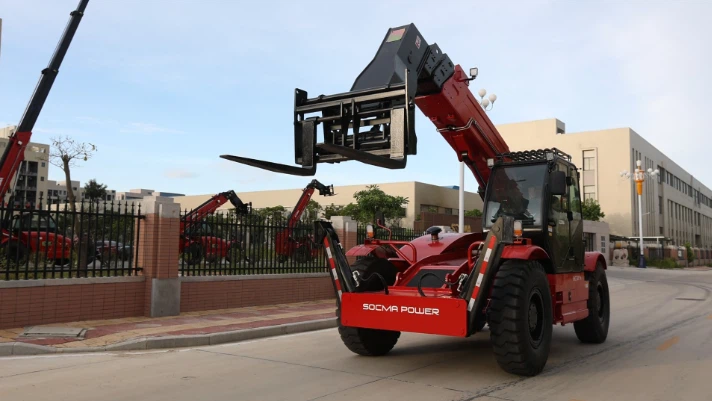
flexibility. The telescopic forklift adopts four-wheel drive, with three steering modes (front wheel steering, four-wheel steering, oblique walking), two-speed gearbox, small turning radius, and can work flexibly, quickly and accurately in a narrow space.
Versatility. Telehandlers are versatile and can work continuously for a long time. A range of quick-change attachments are available, including forks, buckets, lattice booms, vertical masts and more. No need to buy another model, just add a few available attachments to the machine to increase production capacity, forklift flexibility and work efficiency.
Stability and security. The telescopic forklift has a long wheelbase and a low center of gravity. Stable outriggers can be installed at the front of the frame, and the boom has a telescopic automatic locking function. The engine is placed in the longitudinal center of the frame to keep it stable on hills and rough terrain. ;Even weight distribution, four-wheel drive, improve maneuverability on muddy ground, rocky terrain, sand and snow; wide field of vision.
3. Application of telescopic forklift
Telehandlers can use a variety of attachments to effectively complete a variety of different tasks and truly become multi-functional construction machinery. Widely used in agriculture and animal husbandry, logistics, dock operations, aerial work, trailer transportation, urban infrastructure, industrial and mining enterprise warehouses and other construction sites to lift, transport and stack bricks, wood, steel and other materials, becoming a modern industrial and The ideal efficient loading and unloading tool for construction industry and agriculture. With the development of economic construction, the demand for it is increasing, and the requirements for its performance are also getting higher and higher.
4. The status quo of telescopic handlers in China
In 1989, the telescopic forklift truck jointly designed and produced by Xiamen Jiafeng Machinery Factory and Tongji University was a telescopic forklift truck in my country. According to Mr. Wu Xuexi, the person in charge of Xiamen Jiafeng Machinery Co., Ltd. The story of a telescopic forklift: In that year, a Chinese company imported a telescopic forklift from a famous American construction machinery manufacturer, but it failed later because the manufacturer did not have an after-sales service organization and timely supply of spare parts in China. , Resulting in the equipment being idle for many years, Xiamen Jiafeng Machinery Factory exchanged the equipment with a new loader produced by it, and jointly designed and produced a telescopic forklift in China with Shanghai Tongji University.
At present, domestic telescopic forklift truck companies that are active in the country include XCMG Group and South China Heavy Industry. Some companies have been acquired or withdrawn from the forklift market or due to other reasons, and no longer produce telescopic forklifts.
A. Xiamen Jiafeng Machinery Factory
In 1989, Xiamen Jiafeng Machinery Factory and Tongji University jointly designed and produced a telescopic forklift truck, but the development of the telescopic forklift truck was restricted due to product technology, price and market acceptance.
In 2007, Xiamen Jiafeng participated in the Guangzhou Forklift Show for the first time, and exhibited the telescopic forklift for the first time at the 2007 CONEXPO Asia Construction Machinery Expo. In the same year, Xiamen Jiafeng SCZ25-4 telescopic forklift became the designated product of Ordnance of the General Armament Department of the Chinese People's Liberation Army. At the same time, SCZ25-4 was also exported to South America and Africa in batches.
In 2010, the founder passed away unfortunately. In 2012, Xiamen Jiafeng Machinery Factory was acquired by .
B. Sichuan Changjiang Crane Factory
In 1970, in order to meet the needs of national defense construction, Changjiang Crane Factory took the initiative to develop a 16-ton full hydraulic truck crane. The whole plant was prepared for 100 days. In June of the same year, it designed and developed 2 Q2-16 full hydraulic trucks by itself.
In 2000, Sichuan Changjiang Crane Factory cooperated with the General Logistics Institute of Construction Engineering to develop two telescopic boom forklift trucks based on imported American technology. They were successfully trial-produced before October 2000, but they were mainly used for military use. field. Technically, the overall performance of the telescopic forklift has reached a certain level.
In May 2003, Sichuan Changjiang Crane Co., Ltd. passed the reform and restructuring and became Sichuan Changjiang Engineering Crane Co., Ltd. In 2006, Sichuan Changjiang and Terex Corporation (TEREX) joint venture.
C. Xugong Group
The predecessor of XCMG Group was Xuzhou Construction Machinery Manufactory, which was founded in 1948. Since its establishment, it has been a leader in China's construction machinery industry. At the Shanghai BAUMA exhibition in December 2007, XCMG exhibited telescopic handlers. In 2010, XT680-170 telescopic handlers passed the EU CE certification. In 2012, XCMG telescopic handlers were exported to overseas markets in batches, 2013 XCMG's telescopic fork loader realized leasing and opened the domestic leasing market for the first time.
D. Sunward Intelligence
Sunward Intelligent was founded in 1999. The founder is a professor of Central South University and a doctoral supervisor Mr. He Qinghua. He intervened in the forklift industry in 2006. At the 2007 CONEXPO Asian Construction Machinery Expo, Sunward Intelligent secondly trial-produced its successful high-tech The three-section telescopic boom forklift was exhibited and officially entered the field of telescopic boom forklifts.
E. Shandong Binzhou Shengli Special Forklift Factory
Shandong Binzhou Shengli Special Forklift Factory produced a telescopic forklift (STC-30) in 2007 and applied for an appearance patent in February 2008.
F. Sanjiale Construction Machinery Co., Ltd.
At the 2007 CONEXPO Asia Construction Machinery Expo, Sanjiale demonstrated a telescopic forklift.
G. Zhanyang Power Heavy Industry Co., Ltd.
The predecessor of Zhanyang Power Heavy Industry Company was Guiyang Mining Machinery Factory. It was founded in 1936 and developed a high-speed telescopic forklift in 2010. This forklift is the continuation and development of traditional forklifts. Its advantage is The telescopic boom structure is organically
H. China National Machinery Heavy Industry (Luoyang) Co., Ltd.
China National Machinery Heavy Industry (Luoyang) Co., Ltd. (renamed from the original Yituo (Luoyang) Construction Machinery Sales Co., Ltd. in 2011), the LTH3060 telescopic fork loader developed in 2012 was successfully developed and sent to Shandong users.
South China Heavy Industry Telescopic Forklift Truck
I. Fujian Southchina Heavy Machinery Manufacture(SOCMA) Co., Ltd.
In 2012, South China Heavy Industries acquired Xiamen Jiafeng Machinery Factory. In June 2016, the performance test of the HNTR4015 rotary telescopic arm fork-mounted model of the 360° rotating multi-purpose vehicle of South China Heavy Industry was successfully completed. In October 2016, the first 11-ton HNBZ8512 telescopic arm slag raking fork model test was completed. Delivery to users smoothly.
On June 7, 2017, a 11-ton HNBZ8512 telescopic boom slag-skimming forklift with tracked side shift of South China Heavy Industry was successfully delivered to the user. In the same year, in the ChinaGT China Supercar Championship, the 360°rotating telescopic forklift of South China Heavy Industries was able to quickly rescue the championship. In 2017, the telescopic forklift of South China Heavy Industries was exported to overseas markets.
J. Sany Group
Sany Group was formally founded in Lianyuan, Hunan in 1989. On July 3, 2003, Sany Heavy Industries was listed on the A-share market. In March 2014, Sany's SCPS320 heavy-duty telescopic forklift rolled off the assembly line, with a maximum lifting capacity of 32 tons. The large lifting height can reach 6.2 meters, which can stack a full-load 20-foot container in three layers.
5. the reason why telescopic forklift trucks are difficult to popularize in China
A. my country's telescopic forklift truck started late, and there is a gap with foreign countries in overall performance and function.
Although domestic telescopic forklifts have gone through more than two decades of development, they are still in their infancy. There is a certain gap between the basic performance parameters and foreign countries. It is also because the domestic model is single, not in series, and the range of options is small. Domestic telescopic forklifts With fewer attachments, it only realizes the basic functions of a telescopic forklift with multiple functions. When I participated in the Manitou Product (Guangzhou) Exhibition in March 2010, the Manitou telescopic forklift can quickly change the fork into a bucket and turn the forklift into a loader. It can also hold forks, manned platforms, Leveling devices, farm work lifting devices, etc., and the replacement of various devices is very convenient. Bobcat's telescopic forklift can be equipped with more than 20 kinds of attachments such as soil drills, handling forks, buckets, bevel cleaners, planters, and lawn mowers.
B. Technology is the bottleneck, and talent training is the key
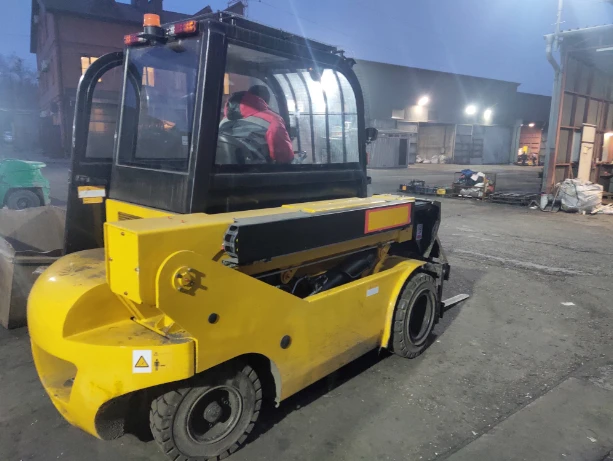
In the application of advanced technology, large foreign manufacturers of telescopic forklifts have vigorously developed and adopted new technologies, new structures and super-functional systems in order to improve the operating efficiency of telescopic forks. The telescopic forklifts also have a dual drive system and reversible drive operation function. Allowing the operator to rotate the seat, especially driving in the opposite direction in the forward state can still achieve the same operating effect, greatly expanding the driver's working range. The key technologies of foreign telescopic forklifts have greatly improved the reliability of the use of telescopic forklifts and reduced the workload of the driver. However, these technologies are not well mastered by domestic enterprises and are rarely used in their production equipment. Of course, XCMG's AC control and ICVD continuously variable transmission effectively solve the walking system solution of telescopic forklifts, and realize the true continuously variable transmission. This is also the progress of domestic telescopic forklifts, but from the perspective of the entire industry, talents The reserve and training work needs to be further improved.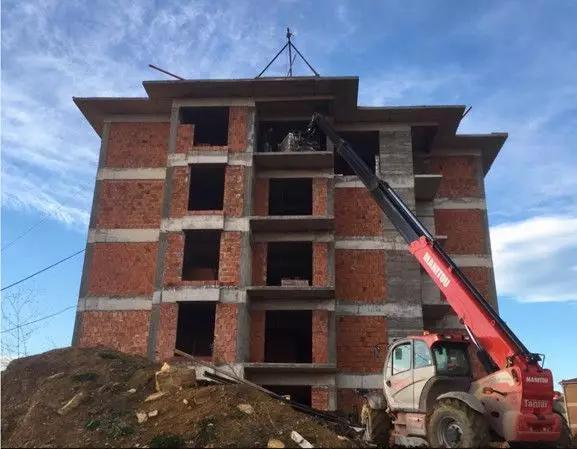
C. The price of imported products is relatively high, and the market acceptance is not enough
my country's telescopic forklift trucks were originally developed and produced as military products. There are basically few applications in the civilian field. In the past two years, the products of a few companies in the market have been used in logistics, agriculture and other fields. Therefore, most of the telescopic forklift truck products appearing and sold in the domestic market are imported brands. Imported products can easily meet the needs of customers in terms of performance and technology, but the price is often relatively expensive, and the price has become a constraint on telescopic forklift trucks. One of the important reasons for the development of cars in China.
D. Insufficient market development and loss of a large number of potential customers
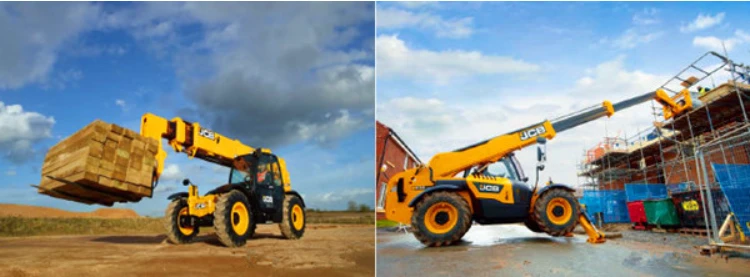
Market demand is a key factor determining the development of the industry. The recognition of telescopic handlers in my country is not very high. The main reason for this situation is that the market environment suitable for the survival of telescopic handlers needs to be further improved. Telescopic forklift trucks are products in subdivisions. At present, before the technology and production capacity reach a certain level, their prices are relatively expensive. In the case of limited consumption capacity in the domestic market, the initial market development requires more manpower, material resources, and In terms of financial resources and time, although some companies are optimistic about the telehandler market, they are reluctant to become testers for initial market development, which leads to the situation that the overall market development of the telehandler industry is insufficient.
6. the breakthrough point of telehandlers in China
A. Intensify research and development efforts, enhance independent innovation capabilities, and continuously improve the technology and quality of telescopic forklift trucks.
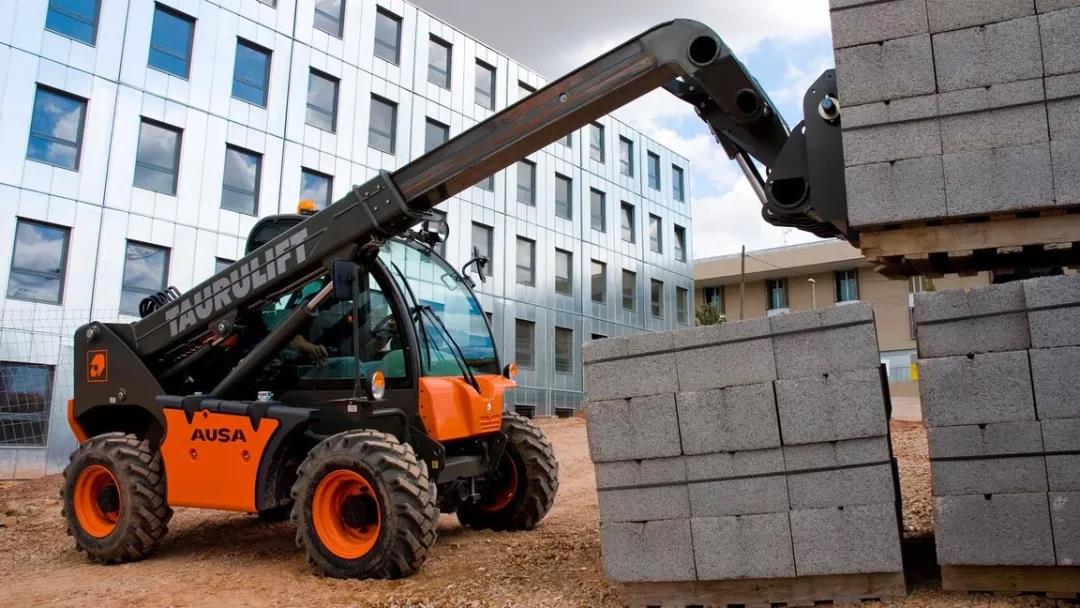
The combination of production, learning, and research is an important direction for independent innovation of an enterprise, as well as a requirement for its own development. The two telescopic forklift trucks produced in 2000 are the result of the cooperation between the Sichuan Changjiang Crane Factory and the General Logistics Institute of Construction Engineering. Can companies consider using their advantages through joint research institutes and universities? Form a new optimized combination of knowledge capital and production factors, actively organize multi-party cooperation and joint research, so that products suitable for market demand can be developed, and the technology and quality of telescopic forklifts can be improved and the company's technical development can be saved. expenditure.
B. Pay attention to the serialization of telescopic forklift trucks and the versatility of body parts
After decades of development in foreign telehandlers, large manufacturers have formed serialized and specialized products, including reprinting and transporting products for small workplaces and general-weight goods, as well as large lifting weights of up to 13 meters. The 40-ton Manitou MHT-X13400, the research and development of foreign construction machinery, not only pays attention to the multi-function of a machine, but also pays attention to the standard inter-matching of body parts to promote the research and development progress of other machinery, save research and development costs, and enhance construction machinery The maintainability, if different equipment can also be realized in China, if the same parts and components can be used, the development and use of telescopic forklift trucks and related products can be promoted to the greatest extent. Use the components and systems of existing products that have been tested and tested to promote telescopic forklifts. For example, consider research and development based on lifting platforms and excavators to develop suitable telescopic forklifts.
C. Change the consumer's mindset
Change consumers' perceptions of prices, advocate rational purchase, rationally analyze the practicability of products, analyze the production needs, financial status, and application scenarios of the company, and analyze the performance that the product can provide and its price level. In contrast, among products at the same price, products that have both performance and price advantages are cost-effective products. In addition, consider the principles of practicality and suitability for enterprises. There is actually a large amount of demand for telescopic forklifts in different domestic industries. For example, some small coal, sand, gravel, feed and other bulk material storage and transportation related companies generally use small and medium sized loaders for material handling and accumulation. Material handling solutions. There are also some common unconventional special loading and unloading and handling operations, such as the following bulk operations in non-fixed places: loading and unloading of non-tilting materials such as open or filled liquid containers, "under the abdomen" small clearance installation engineering, and high-temperature materials Loading and unloading, etc., have always required the use of specific supporting equipment and operating techniques. Compared with the previous material handling solutions using telescopic forklifts, it is of course to choose a solution that can achieve high efficiency and low cost.
Change the consumer's notion of not paying attention to safety, and focus more on the safety of people, things, and equipment. As we mentioned earlier, the use of two forklifts to take risks, using one telescopic forklift can easily solve the problem of handling.
As long as consumers' ideas change, market development will become easier and easier.
D. Green design is the future development direction of telescopic handlers
Environmental pollution and resource shortage have become global problems. Construction machinery is also closely related to environmental protection in the production and use process. The appearance design of the telescopic forklift truck should follow the principles of practicality, economy and beauty, fully embody the harmony of function, form, and color, and the coordination with the working environment, pay attention to the choice of materials and craftsmanship, and obtain a good appearance quality. Green design also includes the control of exhaust gas emissions, research and development of clean energy, and so on.
E. Research on ergonomics
Telehandlers generally work in the field. How to improve the comfort of the working environment, pay attention to the layout of the cab and the comfort of operation, such as the use of an integral pneumatic suspension cab to eliminate the fatigue of the driver.
F. Standards for telescopic forklift trucks
In foreign countries, the American telehandler standard is "RoughTerrain Fork Lifts (ANSI B 56.6)", the Australian telehandler standard is AS1418-19forTelehandlers, and the European telehandler standard is "Safety of industrial trucks-Self- propelled variablereachtrucks (EN 1459)". If there is any update, you are welcome to provide it to us.
The previous domestic standard was the "Specifications for Telescopic Handlers" (GJB4555-2003), which was promulgated by the General Logistics Department of the Chinese People's Liberation Army on December 3, 2003. This specification specifies the requirements for telescopic boom forklifts, which are applicable to OCS2002-3 telescopic boom forklifts. The requirements mainly include basic parameters, product quality and technical requirements, forklift dynamic performance, stability, operational reliability, and reliable driving. Sex, noise, etc.
At present, China's national standards for telescopic forklifts are: GB/T26949.11-2016 Industrial Vehicle Stability Verification Part 11: Telescopic Arm Forklifts and GB/T26949.14-2016 Industrial Vehicle Stability Verification Part 14: Off-road Type Two telescopic forklifts are issued by the General Administration of Quality Supervision, Inspection and Quarantine of the People’s Republic of China and the National Standardization Administration of the People’s Republic of China, and are issued by Hangcha Group Co., Ltd., Beijing Lifting and Conveying Machinery Design and Research Institute, and National Lifting and Conveying Machinery Quality Supervision and Inspection Center Drafted and implemented on May 1, 2017. This part of GB/T26949 specifies the test method for verifying the stability of off-road telescopic forklifts equipped with forks, with or without load handling attachments. This part is not applicable For vehicles designed to move freight containers, lift personnel or suspend goods.
7. The market prospects of telescopic forklift trucks
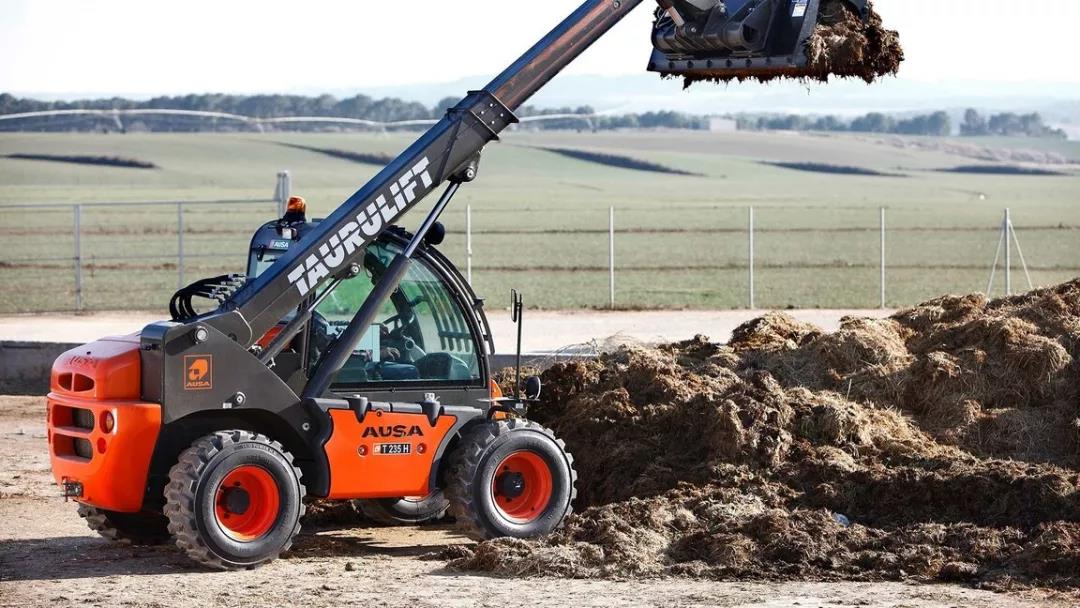
With the rapid development of my country's logistics and installation industries following the international trend, the market for high-lift, large unloading distance loading machinery is increasingly urgent. Because the telescopic forklift has a large operating range and large-stroke extension function, its application range It is also becoming more and more widespread. The popular use of vans, the current operating range of conventional loaders and forklifts do not meet the actual operating requirements, and some unconventional special operations, such as partition wall loading and unloading, cross-ditch operations, etc. For container packing, digging, and stacking operations, for example, the use of telescopic forklifts can shorten the operation cycle and realize high-efficiency and low-cost operations.
Cloud Lan
SOCMA
Sales8@machinery.com
+8617720789242
2022-9-2


